I’m starting to go back through Wang Chuqin’s table tennis career, focusing on key moments and milestones that stand out. His story is still unfolding, and there’s a lot more ahead. But as he once said:
“I think a lot of bits and pieces in the past are more meaningful, because they’re what allowed me to reach where I am today. I also hope you can get to know my journey better and understand me. I’m a table tennis player.”1
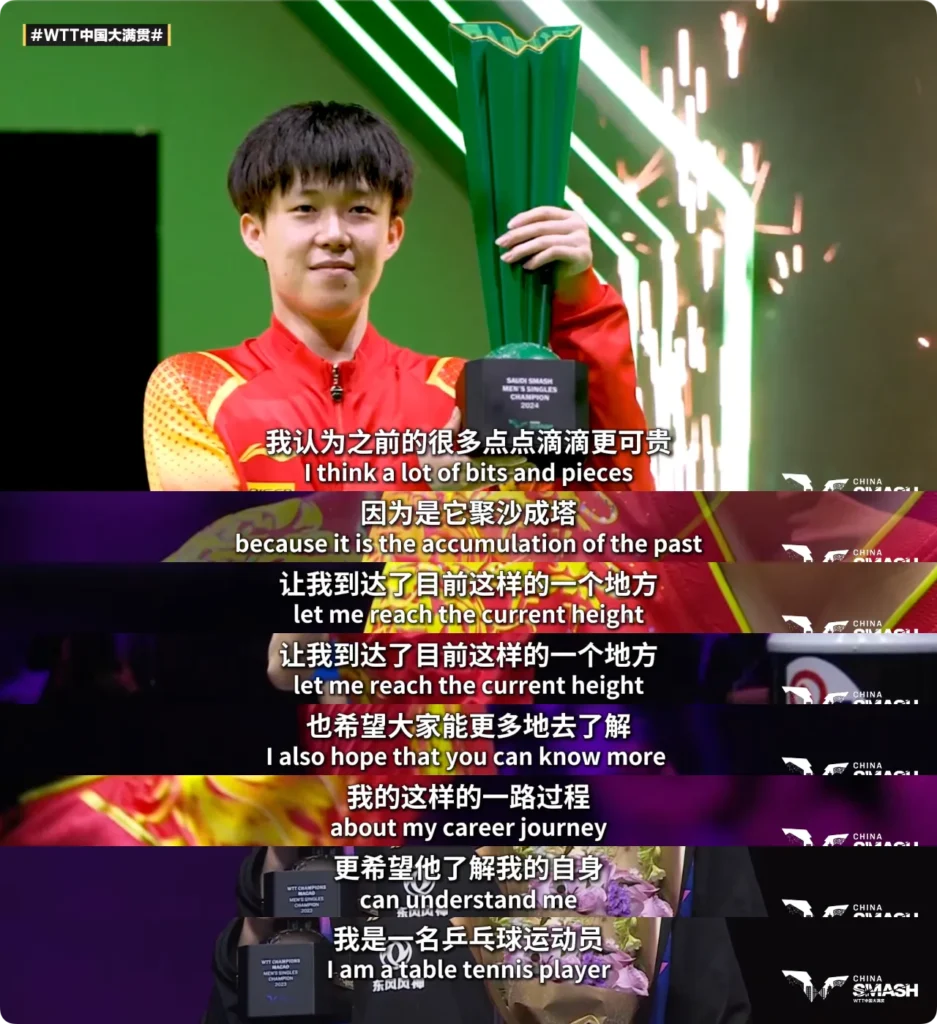
That idea stuck with me. I can’t wait to go back and take a closer look at those “bits and pieces.”
In this series, I’ll step away from a strict timeline and jump between moments whenever something catches my attention. It won’t be posted regularly. Spring break just finished 🙁 and I’m heading to London. 😁
Today, I’m going to talk about 2022, specifically the World Team Table Tennis Championships in Chengdu. It was one of the most important milestones in Wang’s career, and also one of the most intense tournaments the Chinese national team faced in years. Even now, looking back, it still feels breathtaking.
At 4-9, he was on the edge.
Wang Chuqin was trailing in the deciding game, under pressure that went far beyond a single point. Everything around him felt like it was about to collapse, and yet somehow, he held on.
To understand how he got there, we have to go back to 2022. Not just the matches, but the system, the internal competition, and the uncertainty surrounding Team China.
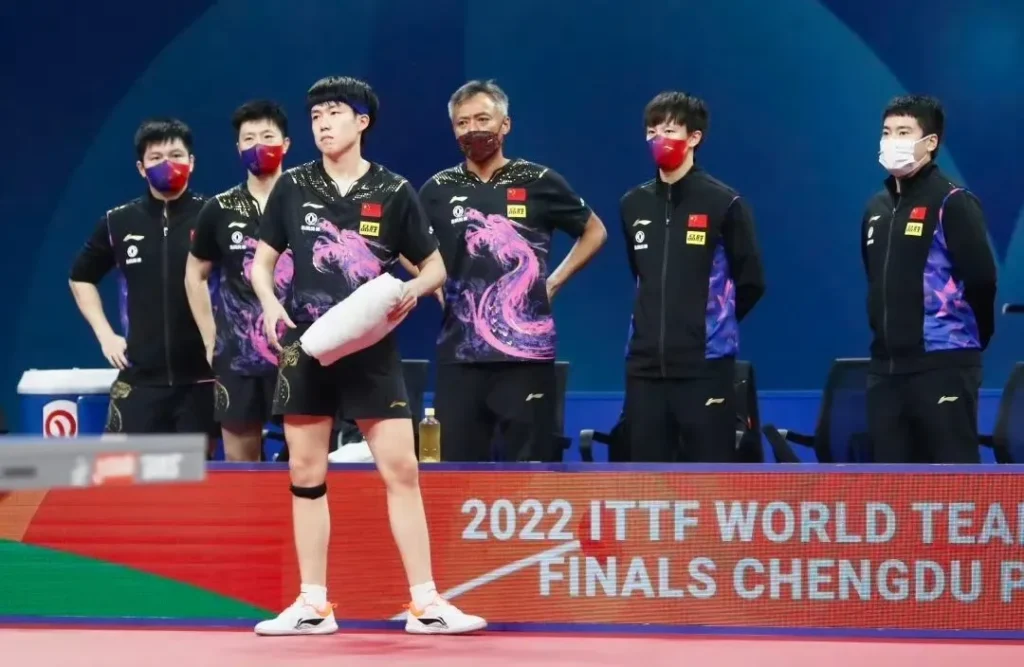
1. Why the 2022 WTTC mattered
The World Table Tennis Championships, held since 1926, are among the most prestigious events in the sport.2 Within that, the team event carries a special weight in China.
The Chinese national table tennis team operates within a state-supported system closely tied to national honor. In that context, team competition is more than sport. It reflects collectivism, and team victory represents national strength and, by extension, national dignity.
China’s dominance makes this even more significant. By far, the men’s team had won 11 of 12 titles since 1995 and maintained a winning streak since 2001. As CNT head coach Qin Zhijian described it, the Swaythling Cup is an honor passed down from generation to generation, carrying the dedication and effort of everyone who came before.3
That consistency builds expectations, and expectations inevitably turn into pressure.
The last time China was pushed to a deciding match at the World Team Championships was in 2001, in Osaka, when Liu Guozheng saved seven match points against Korea. It created one of the most legendary moments in Chinese table tennis history.
Twenty-one years later, in Chengdu, that situation appeared again.
This time, Wang Chuqin was the one standing on the court.
For Wang himself, this wasn’t his first World Team Championship. He had already won team gold in Halmstad in 2018 at just 17, but he didn’t feel he had contributed much, having only played in the group-stage match.
2022 was different.
Throughout this year, Wang fought his way up through uncertainty. Without stable resources and coaching support, he continued competing in WTT events, earning ranking points and remaining in contention. He was also adjusting his equipment and refining his playing style along the way. (More on this in the next post.)
Then he entered Chengdu as the youngest player in the lineup and, for the first time, took on the role of the third core player. That meant facing key matches against experienced, higher-ranked opponents.
The semifinal against Japan brought everything to a peak. On home soil in China. During the Chinese National Day holidays. The first deciding match in over two decades.
He looked stiff.
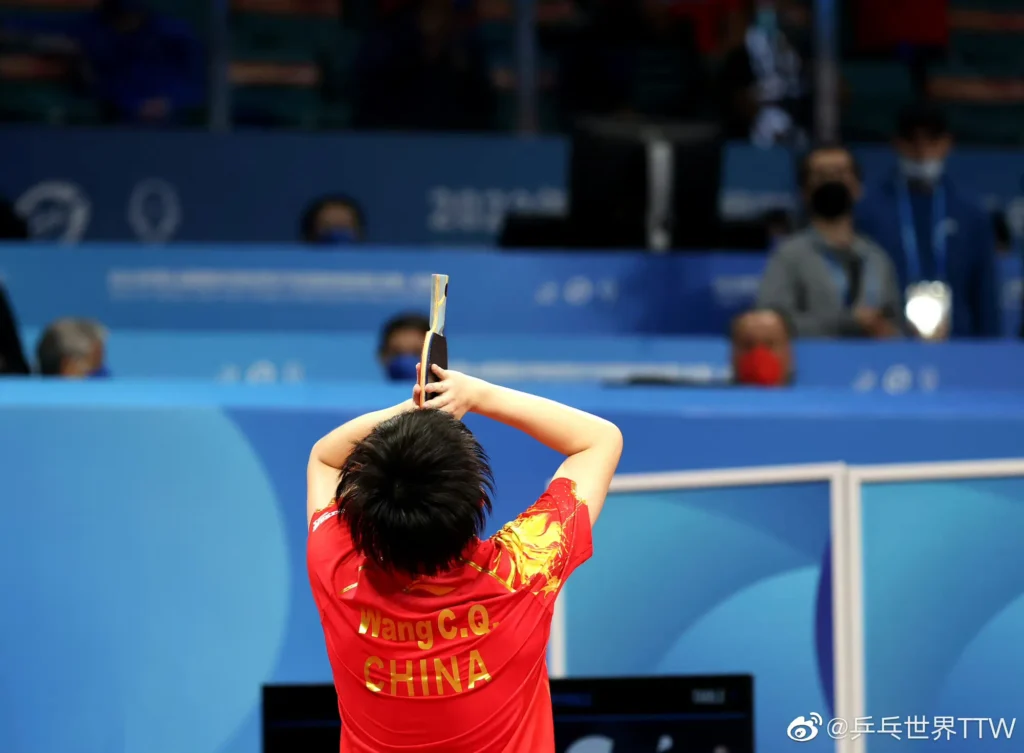
That match, often referred to as “that fifth game,” is widely seen as a turning point in his career. Wang himself described it as a moment between “life and death,” right on the edge.4
2. CNT in 2022:
Transition, Pressure, and the Missing Piece
At the Olympics, each country can only send three male players. The World Team Championships, which feature five-player teams, are often used to shape that Olympic core.
Traditionally, China follows a “the old leading the new” pattern. Veterans stabilize the team while younger players grow into their roles. Over time, that structure forms both the “core three” and the broader “main five.”


But after the Tokyo Olympics and the Houston WTTC, that structure was reshaped and became more fragile.
The so-called “1992 generation,” including Fang Bo, Yan An, and Zhou Yu, reached their late twenties without ever fully securing their positions. and exited the national team in late 2021. They were expected to bridge the gap between the older generation and the next wave of players, especially as Ma Long and Xu Xin approached the later stages of their careers, but that transition never fully materialized. The team’s development structure ended up with a gap in the middle.
Xu Xin, who came back from the painful Tokyo Olympics, gradually stepped away from the international stage in early 2022.
That left the “core-three” with just Ma Long and Fan Zhendong.
Fan Zhendong, at 25, was in his prime and expected to lead. Ma Long, on the other hand, seemed to have already achieved everything. Five Olympic gold medals, a double Grand Slam, and a GOAT in table tennis. But at 34, the question was unavoidable.
Would he retire?
Some people even joked that if Ma continued all the way to the next Olympics, it would mean the CNT’s Echelon System had broken down internally. Looking back, we know he did exactly that, competing at the Paris 2024 Olympics as a four-time Olympian. But in 2022, that future was still uncertain.
China didn’t just need strong players. It needed someone who could step into the core structure and carry responsibility moving forward. The lineup in 2022 was about Paris 2024, about who would represent the next generation, continuing the system.
The calling was urgent: There was at least one open spot in the core squad.
Possibly two.
3. Internal Competition: A System Puzzle
Several players were competing for that position. According to the 2022 world rankings, the main candidates behind Fan Zhendong and Ma Long were Liang Jingkun (age 26), Wang Chuqin (age 22), and Lin Gaoyuan (age 26).
Although Liang Jingkun’s performances against international opponents were inconsistent and raised concerns, he still seemed like the most straightforward choice, even a potential successor to Ma Long. His position remained relatively stable, which meant the real competition centered on Wang Chuqin and Lin Gaoyuan.
Both were left-handed.
Within the CNT system, left-handed players have long faced a certain level of bias. They are often placed in more supportive roles, especially in major competitions where doubles play is critical.
From that perspective, within the right-handed center theory, their value is sometimes defined by how well they complement right-handed players. Both Wang and Lin had established strong partnerships with the team’s main right-handed players over the years. Wang frequently paired with Fan Zhendong and Ma Long, while Lin often partnered with Liang Jingkun and Ma Long.
At that point, the comparison was clear. Wang was younger and less experienced, while Lin had more experience and established support.
Rather than performance alone, it was about how the system saw them.
Battle between lefties.
Then another factor came in.
Mixed doubles were added to the Olympic program in Tokyo 2021, and China unexpectedly lost the gold medal to Japan. That loss mattered, and reclaiming it became a priority, which changed selection logic again.
One came from the Olympic core-three had to be specialized in mixed doubles.
Both Wang and Lin were strong mixed doubles players.
So the competition extended again. Now it involved singles performance, doubles compatibility, mixed doubles potential, and overall system preference.
It became a system-level choice with multiple variables.
4. Selection for Chengdu
On August 24, 2022, the Chinese Table Tennis Association announced the selection rules for the “main five” in Chengdu.5
The top four players in the world ranking (as of August 23) would qualify directly, while the final spot would be decided through an internal match.
At that point, Fan Zhendong was world No. 1, Ma Long No. 2, and Liang Jingkun No. 3. Wang Chuqin, ranked No. 11 globally and fourth within China, secured his place on the team. (I’ll go into more detail on how he fought for his place in a later piece.)
Lin Gaoyuan, just behind him, later won the internal match and claimed the final spot.
The lineup was set.6
It was considered a strong and well-balanced combination, one that would remain stable in major competitions over the next two years. Also, my favorite.
Wang Chuqin was part of it.
Not the most experienced. Not the most certain.
But in Chengdu, when everything came down to one moment, standing right on the edge, he was the one there.
Leave a Reply