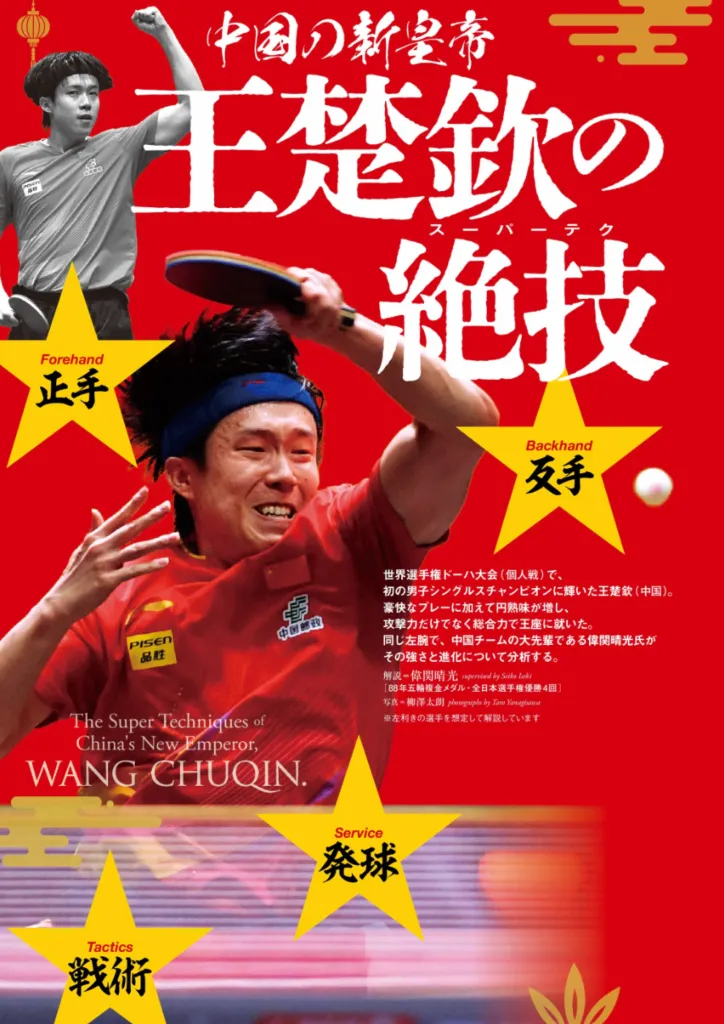
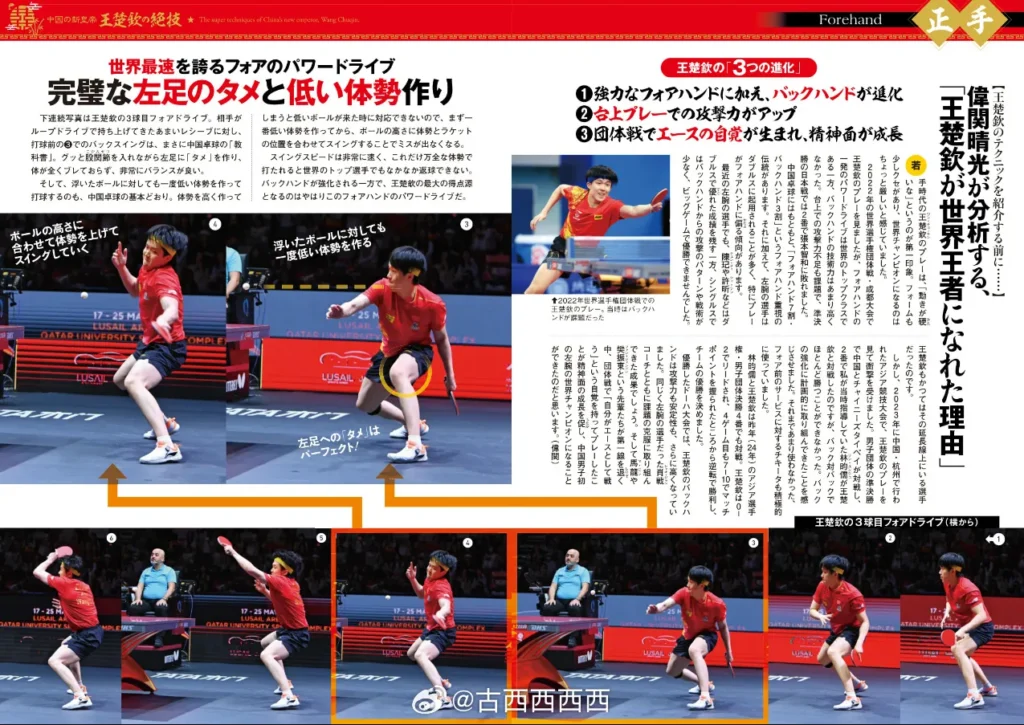
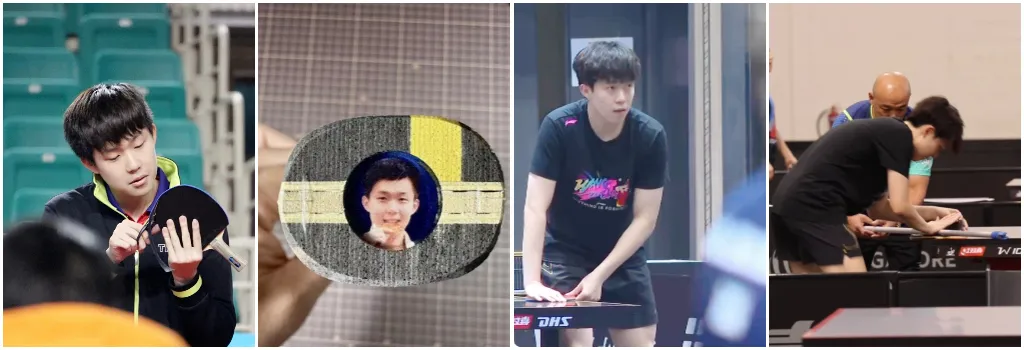
Former coach of Japan and Chinese Taipei Wei Qingguang (Seiko Iseki) breaks down Wang Chuqin’s recent developments in forehand, backhand, serve, and tactical play.
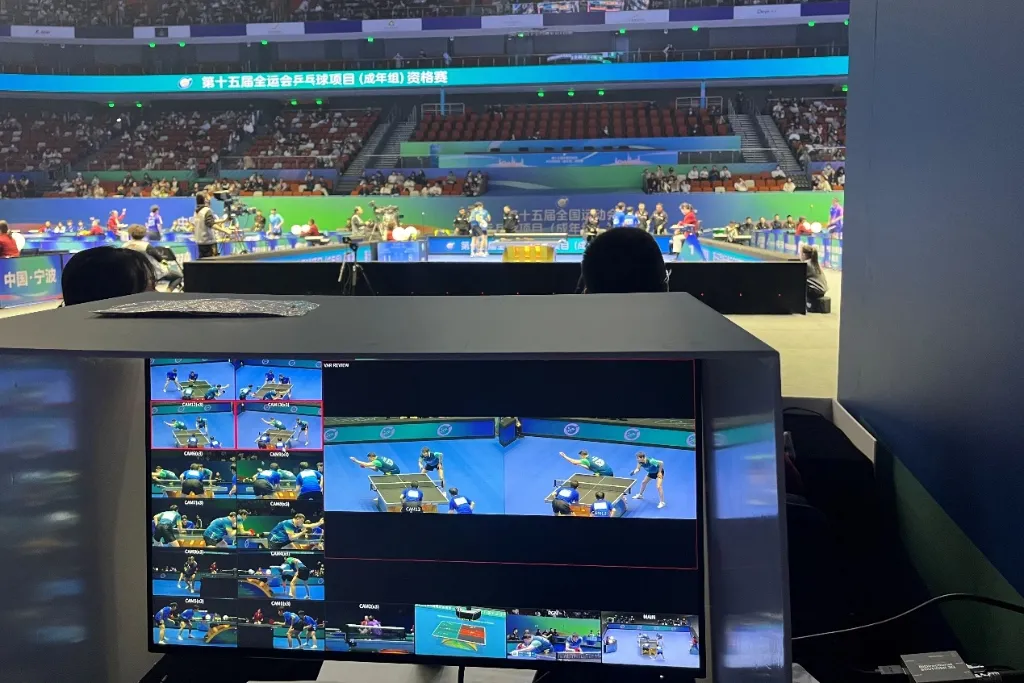
Ever since the Hawk-Eye-based Table Tennis Review (TTR) system arrived at the 2025 World Cup and World Championships, officiating in table tennis has taken a big step forward. Technology is playing a direct role in making calls and has changed how the game feels and flows in a big way.
Watching matches now is just smoother, with fewer nonsense distractions. That endless back-and-forth from online couch critics, grabbing blurry screenshots to defend or attack whoever they like or dislike, no longer holds up. Wang Chuqin, in particular, has endured years of harsh and often unfair heat over his serve. I’ve talked before about why screenshots aren’t solid evidence in these debates, but now with TTR in place, we can finally assess how this system has actually worked so far.
This 26-minute interview is a deep dive into Wang Chuqin’s quiet reflections and raw honesty, captured by CCTV’s Face to Face. What shocked me most was that he actually considered walking away from table tennis after the Paris Olympics. And there’s more, but you’ll have to watch it yourself. 😉
It’s clearly a very Chinese-style interview, where the guest is guided to reflect and, in some ways, glorify suffering. But I’m glad Wang stayed true to himself and kept sharing his real thoughts, just like he always does.
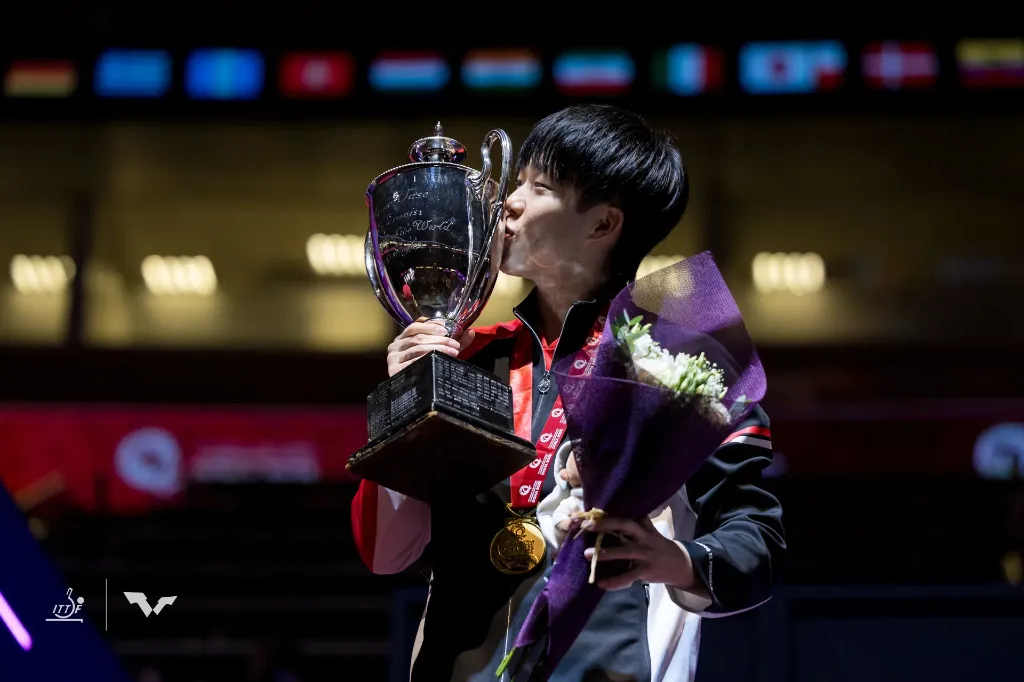
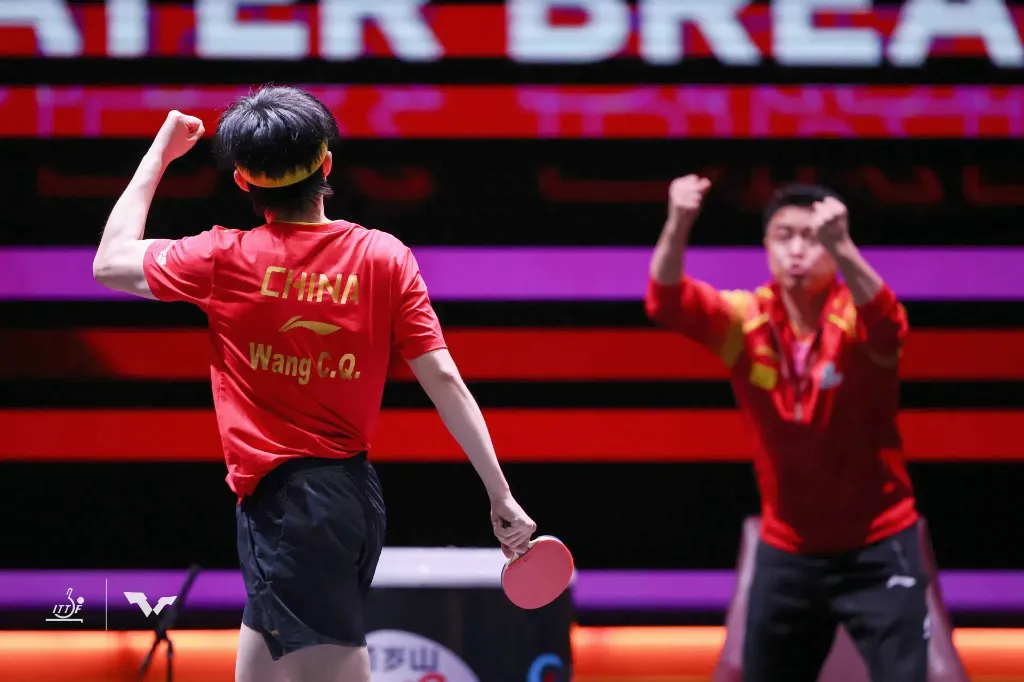
Huge congrats to our Wang Chuqin, the newly crowned men’s singles World Champion. It’s even more special because he’s the first Chinese left-hander ever to achieve it. With this victory, Wang now holds titles in singles, doubles, mixed doubles, and teams at the World Table Tennis Championships. A WTTC full house. A remarkable milestone in his career.1
Wang and his St. Bride VaseWang raised his left arm in a proud fist.
But what stood out most was Wang’s reaction. Calm.
It happened again. Wang Chuqin’s racket got damaged right before the match, at the biggest event of the year: the 2025 World Championships in Doha. The trauma from the Paris Olympics, when a photographer cracked his racket on court, came rushing back. It hit like a sudden PTSD flash.
In table tennis, even the tiniest equipment tweak can throw everything off. Things like rubber thickness, blade construction, table surface, and even the arena’s humidity all shape how the game plays out. At the pro level, players rely on split-second timing, sharp instincts, and a fine-tuned sense of touch. When the feel changes, the whole balance collapses.
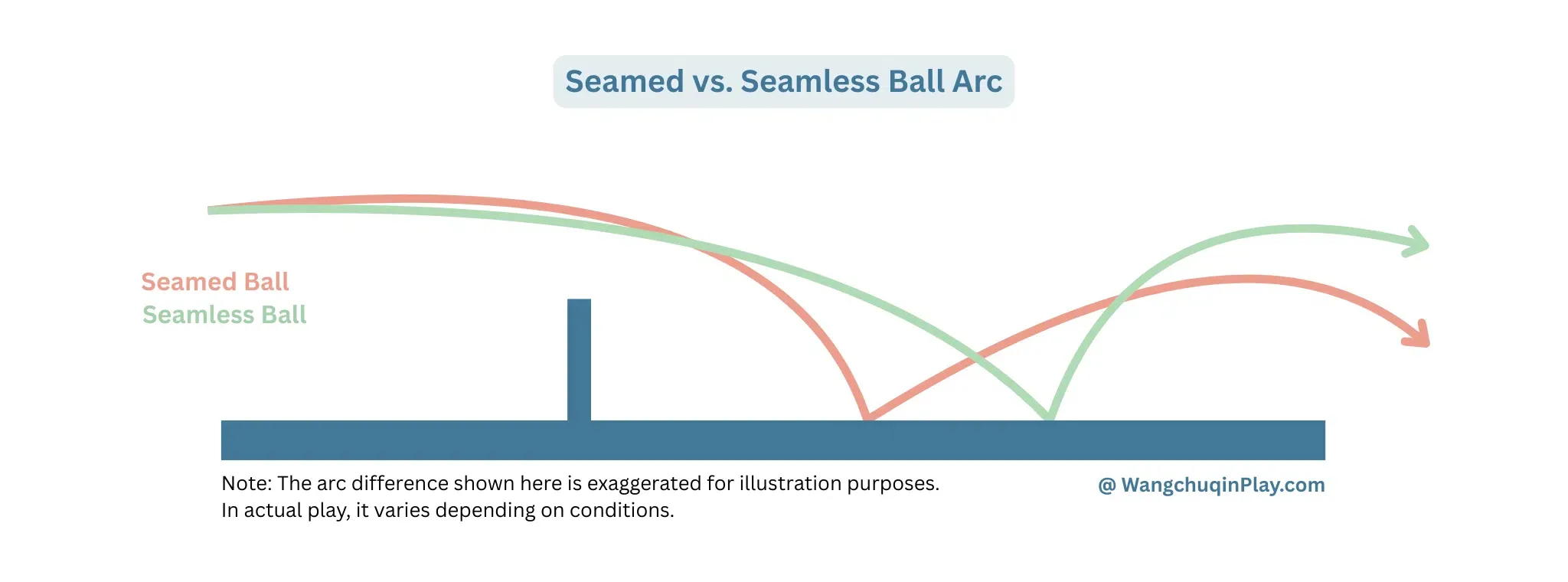
I started looking into seamless balls after noticing how many top players struggled at the 2024 Asian Championships and the 2025 World Cup. Their timing looked off, shots felt disconnected, and many just couldn’t find their groove. The deeper I looked, the more it felt like a rabbit hole. I’m still connecting the dots, but here’s what I’ve learned.
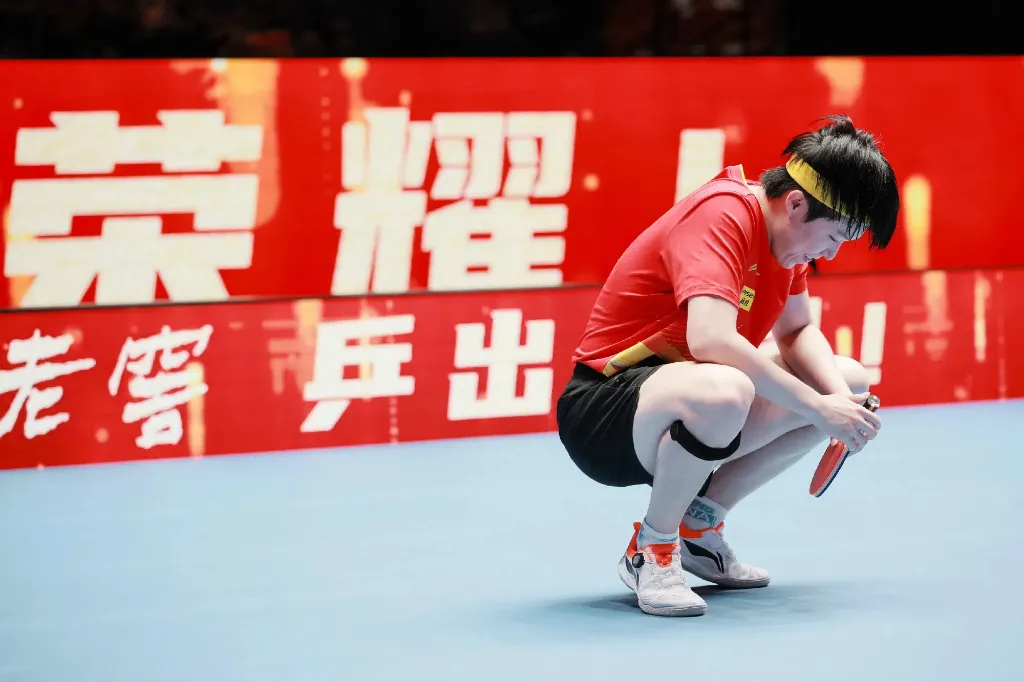
Wang’s 2025 World Cup just wrapped. In the semifinals, he lost to Hugo Calderano, 10-12 in the deciding seventh game. When the last ball dropped, Wang Chuqin squatted down and wiped the sweat off his face with his arm. Then he smiled. Regret thickened the air like humidity before a storm. The crowd felt it. For Wang, alone at the center, it had to be a thousand times heavier. But still, he smiled.
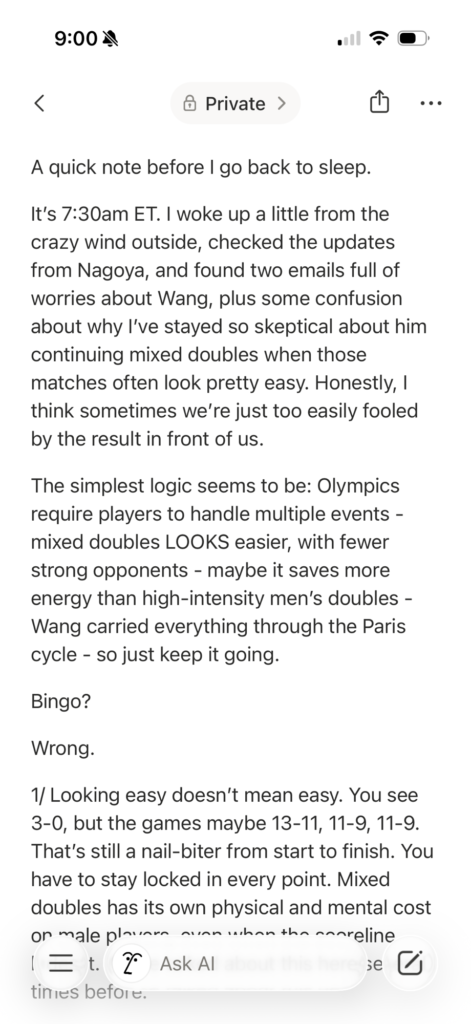
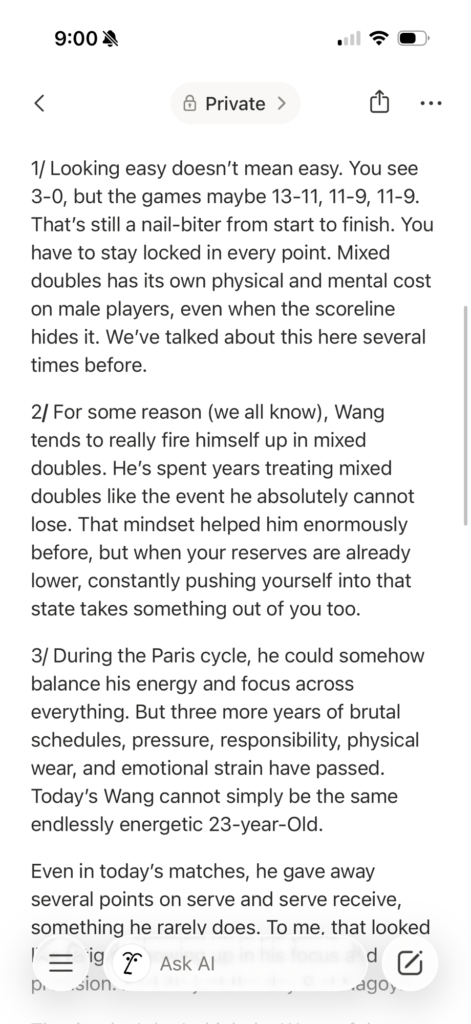
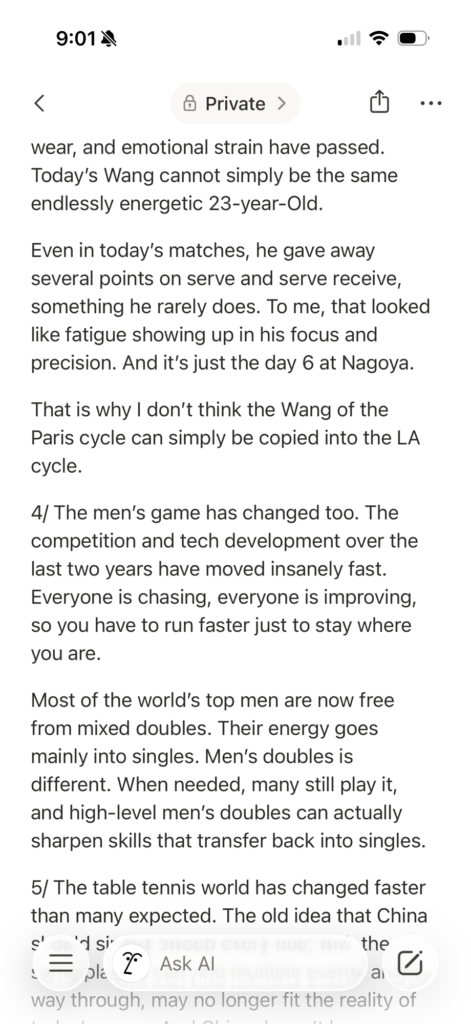
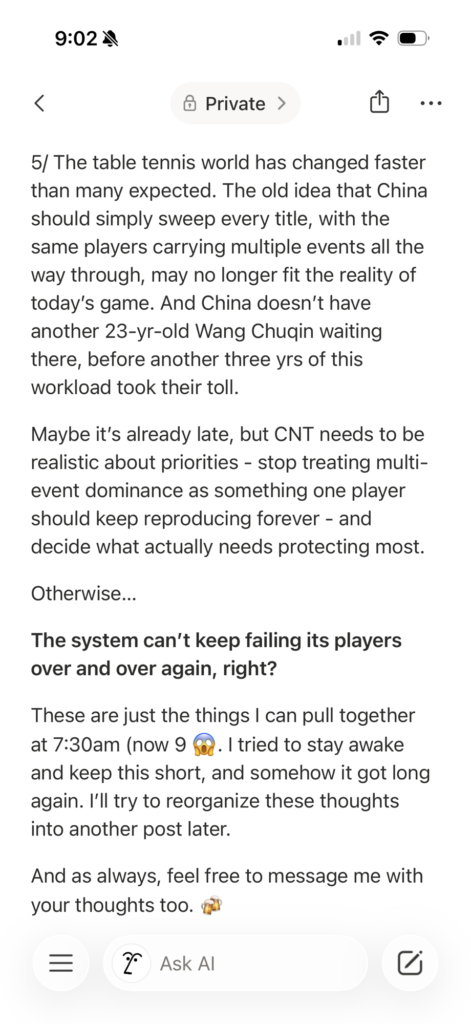
Sept 25, 2026: It’s 7:30am ET. I woke up a little from the crazy wind outside, checked the updates from Nagoya, and found two emails full of worries about Wang, plus some confusion about why I’ve stayed so skeptical about him continuing mixed doubles when those matches often look pretty easy. These are the things I can pull together at this moment. I tried to stay awake and keep this short, and somehow it got long again. I’ll try to reorganize these thoughts into another post later. And as always, feel free to message me with your thoughts too. 🍻
Sept 24, 2026: The Chinese men’s team failed to defend its Asian Games title today. Honestly, the result didn’t feel completely unexpected. Many had already thought something like this might happen in London months ago.
Beyond technique and individual form, two familiar problems about CNT showed up again. First, as always, the coaching looked overconfident and underprepared. Changing the usual lineup order and putting WRB, a complete newcomer to the team event, in a position where he might have to play twice in the final was a huge risk. We understand the logic behind the decision, but the plan still seemed to depend on Wang Chuqin taking both of his matches and keeping China away from the decider, leaving almost no room for error. The player CNT relies on most is also the player it keeps asking to carry the most.
This lineup also took me back to the 2022 Chengdu World Team Championships semifinal against Japan (Wang’s 2022: The Year Chengdu Changed Everything). China’s A-position player FZD won one match and lost the other, much like Wang today, while Wang, then the newcomer in the B position, recovered from his first loss to win the decider and send China through 3-2. Today, WRB was put in almost exactly the same position and couldn’t pull it off. But I don’t blame him. You can’t expect every young player to be another young Wang Chuqin.
Then there’s the workload.Once again, we clearly see what shouldering multiple events at once can eventually demand from a player. Just the day before, Wang had played five matches within 24 hours, constantly switching between events and the different demands each one brings. More on that here:Structural Fatigue. Unsustainable, and Wang’s Extra Burden in Mixed Doubles.
Wang has carried one of the toughest workloads in world table tennis for years. The three years since the Hangzhou Asian Games aren’t three ordinary years.You can’t expect today’s Wang to still have the physical freshness, energy, and fire of his 23-year-old self while also carrying three more years of experience, responsibility, and pressure. For too long, it has felt like CNT kept borrowing from his future to solve the present.
Add the pressure of carrying the whole team, and today looks less like something that suddenly went wrong than something the system had been leaving itself open to for years. Maybe today. Maybe much earlier. Japan earned the win. But from the Chinese side, this loss doesn’t belong only to the players at the table. The system failed them too.
If this isn’t a wake-up call for the CNT coaches, I don’t know what is. 📢 Though I doubt they’ll change.
Sept 15, 2026: A month of on-set work, way too many boring NYFW runway reviews, a sprained wrist, and summer-to-fall allergies later… 😪 I’m finally ready for the Asian Games. With Aichi-Nagoya coming up this weekend, time to look back at Hangzhou 2023: The Four-Title Crown: Wang at the 2023 Hangzhou Asian Games
If you’ve watched Wang Chuqin play, you already know it’s wild, fast loops, nasty spin, and full of fire. A big part of that is his finely tuned weapon: the racket. And just as his playstyle has evolved, Wang’s racket setup has undergone profound changes over the years.
This post is all about what makes a pro racket, how Wang’s gear has evolved, and a few stories along the way, some cool and some kinda painful. Let’s get into it.
Wang Chuqin’s journey hasn’t followed the typical “find a mentor, rise to the top” storyline. Instead, he’s had to navigate a complicated maze of favoritism, random coach swaps, and limited resources. In a system where standing still means falling behind, most core CNT players have long benefited from dedicated supervising coaches, but Wang didn’t. He spent key years bouncing from one coach to another. Or sometimes, left completely on his own.
To provide the best experiences, we use technologies like cookies to store and/or access device information. Consenting to these technologies will allow us to process data such as browsing behavior or unique IDs on this site. Not consenting or withdrawing consent, may adversely affect certain features and functions.
Functional
Always active
The technical storage or access is strictly necessary for the legitimate purpose of enabling the use of a specific service explicitly requested by the subscriber or user, or for the sole purpose of carrying out the transmission of a communication over an electronic communications network.
Preferences
The technical storage or access is necessary for the legitimate purpose of storing preferences that are not requested by the subscriber or user.
Statistics
The technical storage or access that is used exclusively for statistical purposes.The technical storage or access that is used exclusively for anonymous statistical purposes. Without a subpoena, voluntary compliance on the part of your Internet Service Provider, or additional records from a third party, information stored or retrieved for this purpose alone cannot usually be used to identify you.
Marketing
The technical storage or access is required to create user profiles to send advertising, or to track the user on a website or across several websites for similar marketing purposes.